1964 – St. Mary Cathedral – Kenzo Tange

The St. Mary Cathedral has been completed in 1964, replacing the old wooden cathedral, in gothic style, burnt during wartime. Tange conceived the new church as a concrete structure, simple in concept and complex in shape, which recalls the lightness of a bird and its wings. The eight walls – the elements which hold the whole structure – are at the same time roof and walls, enclosing the space and opening to the outside through vertical gaps. The walls are curved hyperbolically to express the tension to the sky, and turning the rhomboidal ground floor into a cross at the roof top. The different heights of the wings, asymmetrical, make it a dynamic shape on the sky background. The highest wing is 39,41 m high.


The reflection of the sunlight on the stainless steel external cladding looks as a shining dress on the hard concrete slabs. Although it is a monochromatic cladding, the curves and the U-shaped profiles enhance the dynamicity of the structure. It all makes the church an iconic building in the dense urban context of Tokyo. The effect of the light on the curved walls, changing at every hour, makes the interior atmosphere extremely involving: direct sunlight and diffused reflections accompany the bending surfaces, and the visitor can immediately see and understand the curving of the concrete walls. St. Mary Cathedral is considered one of the most important of Tange’s work, and one of the most interesting architectures in Tokyo. The building puts together an occidental subject and the oriental culture and sensibility, resolving the complexity of the project in a brilliant architecture.

Name: St. Mary Cathedral│Type: Church│Architect: Kenzo Tange│Completed: 1964

Location

1964 – Nippon Budōkan – Mamoru Yamada

In 1964, the inauguration of two buildings designed by the Japanese architect Mamoru Yamada have sparked a lot of controvers. If the lighthouse shape of the Kyoto Tower was criticized by being too modern for the ancient city, the Japan Martial Arts Hall – Nippon Budokan – from Tokyo was criticized for being too traditional.

Built for the Judo competition of the 1964 Olympics, the Budokan’s architecture was inspired by an old architectural masterpiece, the Yumedono (Hall of Dreams) from Hōryū-ji, Nara, the most famous building of its kind. The architect preserved in its design both the underlying pedestal and the octagonal shape of the roof , with a big giboshi (sacred gem protecting against evil spirits) on top.


Name: Nippon Budōkan│Type: Stadium│Architect: Mamoru Yamada│Completed: 1964

Location

1959 – Setagaya Ward Office – Kunio Maekawa

Setagaya Ward Office is an expetional exmaple of Kunio Maekawa’s facing concrete work. Outstanding is the folded plate structure of the auditorium. The concrete there becomes a impressive sculptural quality. Maekawa designed at the same time a similar auditorium  building for the UNSECO in Paris. In this work the strong influence by Le Corbusier is obvious. On June 25 2016, Setagaya Ward announced that they are considering demolishing and rebuilding the ward office buildings. The building do not meet current earthquake codes and could be at risk of collapse in a large earthquake.


Name: Setagaya Ward Office│Type: Administration│Architect: Kunio Maekawa│Completed: 1959

Location

1964 – Yoyogi National Gymnasium – Kenzo Tange

Built for the 1964 Summer Olympic Games in Tokyo the Yoyogi National Gymnasium has become an architectural icon for its distinctive design.  Designed by one of Japan’s most famous modernist architects, Kenzo Tange, the gymnasium is a hybridization of western modernist aesthetics and traditional Japanese architecture. Tange’s innovative structural design creates dramatic sweeping curves that appear to effortlessly drape from two large, central supporting cables. It’s dynamically suspended roof and rough materials form one of the most iconic building profiles in the world.


Name: Yoyogi National Gymnasium│Type: Sports│Architect: Kenzo Tange│Completed: 1964

Location

1964 – Komazawa Olympic Park Control Tower – Yoshinobu Ashihara

This iconic concrete tower designed by architect Yoshinobu Ashihara became the outstanding landmark of Konazawa Olympic Park. Its structure refers to traditional Japanese wood architecture, but is transformed to a modernist shape and construction. What originally was facing concrete is today unfortunately painted white.


Name: Komazawa Olympic Park Control Tower│Type: Infrastructure│Architect: Yoshinobu Ashihara│Completed: 1964

Location

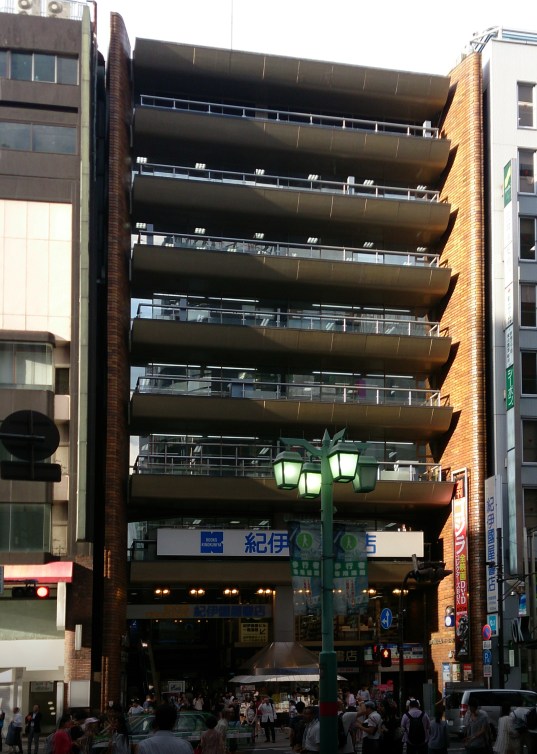
1964 – Kinokuniya Bookstore – Kunio Maekawa

1964 Kinokuniya Kunio Maekawa

After World War II Kunio Maekawa founded a company specialized in production of prefab concrete elements which you also find in this project: The 40 meters deep and 9-storey high building is placed in the busy shopping area of Shinjuku. Its basement is directly connected to the subway station. Originally the Kinokuniya bookstore was only on the first and second floor – besides there was also a restaurant and an auditorium. Today the complete building is used as a bookstore.


Name: Kinokuniya Bookstore│Type: Commercial│Architect: Kunio Maekawa│Completed: 1964

Location

1962 – Komazawa Olympic Park Stadium – Murata Masachika Architects

The Olympic Park was the site of the second venue for the Tokyo Olympics in 1964, hosting wrestling, volleyball, and other competitions. It was opened to the public after the Olympics as a park, and today is known as a sports park that harmoniously blends greenery with several types of athletic facilities.

Komazawa Olympic Park Stadium is a multi-purpose stadium and currently used mostly for football matches (although mostly amateur and women’s matches) as well as American football games and athletics. The stadium holds 20,010 people. The stadium hosted some of the football preliminaries for the 1964 Summer Olympics. Worth seeing is the plant-like concrete structure of the roof on its west side.


Name: Komazawa Olympic Park Stadium│Type: Stadium│Architect: Murata Masachika Architects│Completed: 1962

Location

1959 – National Museum of Western Art – Le Corbusier

The Main Building was designed by the Le Corbusier (1887–1965). It is the only representative example of his work in the Far East; and the New York Times review of its opening suggested that the building itself presented an “artistic significance and beauty” which rivaled the paintings inside. The multi-story, reinforced concrete building was completed in March 1959. Le Corbusier asked that his three Japanese apprentices: Kunio Maekawa, Junzo Sakakura and Takamasa Yoshizaka be responsible for developing the detail drawings and supervising the construction.

The museum is square in plan with the main body of the galleries raised on piloti to first floor level. The layout is influenced by Le Corbusier’s Sanskar Kendra museum in Ahmedabad which was being designed at the same time. Entrance for visitors is at ground floor level via the 19th Century Hall. This double height space is lit from above with a north glazed pyramidal skylight intersected with reinforced concrete beams and a column. The paintings gallery wraps around 19th Century Hall, the ceiling is initially low but is raised to two storeys around the perimeter to display the paintings. Externally the building is clad in prefabricated concrete panels which sit on U-shaped frames supported by the inner wall. The building generally is constructed of reinforced concrete and the columns have a smooth concrete finish.

In July 2016 UNESCO listed 17 works by Le Corbusier as World Heritage Sites, including the 1959 National Museum of Western Art building


Name: National Museum of Western Art│Type: Museum│Architect: Le Corbusier│Completed: 1959

Location

1935 – Asakura Choso Museum – Fumio Asakura

It took seven years from 1928 to 1935 to build the Asakura Museum of Sculpture. Originally it was Fumio Asakuras home and studio. Although seven years of the construction period seems very long, sculptor Asakura himself was involved in the design and the supervision of the construction, so it was built in a way that an ordinary architect did not adopt. The modernist studio wing’s exterior concrete wall is painted black, and white can be seen in the courtyard. Here is also a contrast between black and white. As to the traditional Japanese residential wing, new materials were already applied to the walls, so we probed traces of the original walls that Asakura actually made. As a result, it turned out that red and black sand, fibers, mortar, and mortar mixed with lampblack were used for the walls.


Name: Asakura Museum of Sculpure│Type: studio, residential│Architect: Fumio Asakura│Completed: 1935

Location

1942 – Maekawa House – Kunio Maekawa

Kunio Maekawa is one of the most influential Japanese modernist architects who studied in France to apprentice for Le Corbusier and later designed the Tokyo Metropolitan Art Museum during the 60s. His original house has been dismantled and relocated to the Edo-Tokyo Open Air Architectural Museum. Maekawa house was originally built in 1942 during the wartime regime. The interior was a very exquisite blending of Japanese construction and Western functional taste. Unbelievable that it was made during the wartime especially with the shortage of materials.


Name: Maekawa House│Type: residential│Architect: Kunio Maekawa│Completed: 1942

Location