1983 – GA Gallery – Makato Suzuki (AMS Architects)

This exposed concrete building, which accommodates a gallery and bookstore dedicated to architecture and the offices of the publisher of GA, is on a narrow side  street, halfway between Yoyogi and Omotesando station. The interior of the building offers a spatial variety, while the surface of the walls, floor and ceiling is either in exposed concrete, steel or glass constructed, which creats an atmosphere of roughness.


Name: GA Gallery │Type: Gallery and Office│Architect: Makato Suzuki (AMS Architects)│Completed: 1983

Location

1982 – Tokyo Union Church – Heng Kitayama (Nishimatsu Construction)

Tokyo Union Church is located right at the busy, fancy and famous Omotesando shopping street. A close look reveals various curious forms found on the exterior of the building. Hence the building has been executed in somewhat of an anomalous style compared to the other familiar design in the vicinity.


Name:  Tokyo Union Church │Type: Church│Architect: Heng Kitayama (Nishimatsu Construction) │Completed: 1982

Location

1982 – Embassy of Brazil – Ruy Ohtake

The Embassy of the Federative Republic of Brazil is characterised by its curved façade and a yolk-yellow volume organised around a small square in front of the building. Its Niemeyer- and Artigas-influenced architect, Ruy Ohtake, was born in São Paulo as son of the Nippo-Brazilian artist Tomie Ohtake.


Name: Embassy of Brazil │Type: Office│Architect: Ruy Ohtake │Completed: 1982

Location

1980 – Shoto Museum of Art – Seiichi Shirai

This quite strange piece of 80s architecture is situated in an upscale residential district not far from the busy and fancy Shibuya shopping an entertainment area. Although the building accommodates special exhibits, lectures and workshops for the public, the facade suggests, not a community facility, but a maximum security prison. As in the Noa Building, the entrance is a narrow slit in a rouhly-textured wall.

The wall is clad in Korean granite, and bronze louvers are installed over the opening. Translucent panels of onyx form the ceiling over the vestibule. There are four levels to the building, of which two are belowground, and the spaces are organized around a deep lightwell. After the dramatic buildup, the lightwell is something of anticlimax. The well, adorned with fluted cast-aluminium columns, is spanned by a bridge. Fountains discharche weak trickles of water at the bottom of the space. The gallery, crescent-shaped, is a two-story space overlooked by a gallery.


Name: Shoto Museum of  Art │Type: Museum│Architect: Seiichi Shirai │Completed: 1980

Location

1979 – University of Tokyo Administration Bureau – Kenzo Tange


Administration Bureau Building 1 was designed by Kenzo Tange, and was built in 1979. It is located near the Tatsuoka mon; and, as its name suggests, it is used as the head office of the University. The building has 12 floors, which was uncommonly tall for 1979. Administration Bureau Building 2 was finished in 1976 as Faculty of Science Building 7. It was also designed by Kenzo Tange. The building is situated next to the Administration Bureau, and its design is similar to that of the latter. At first, the building was used for the mathematics, science, and geological science departments. The architecture of both buildings is exemplary for Tange’s late structuralism. The very solid and closed towers at each corner supports the structural clarity of the buidling. It’s expression is similar to an medieval castle, but in a modern construction.


Name: University of Tokyo Administration Bureau 1 / 2│Type: Office│Architect: Kenzo Tange │Completed: 1976 / 1979

Location

1979 – Royal Danish Embassy – Fumihiko Maki

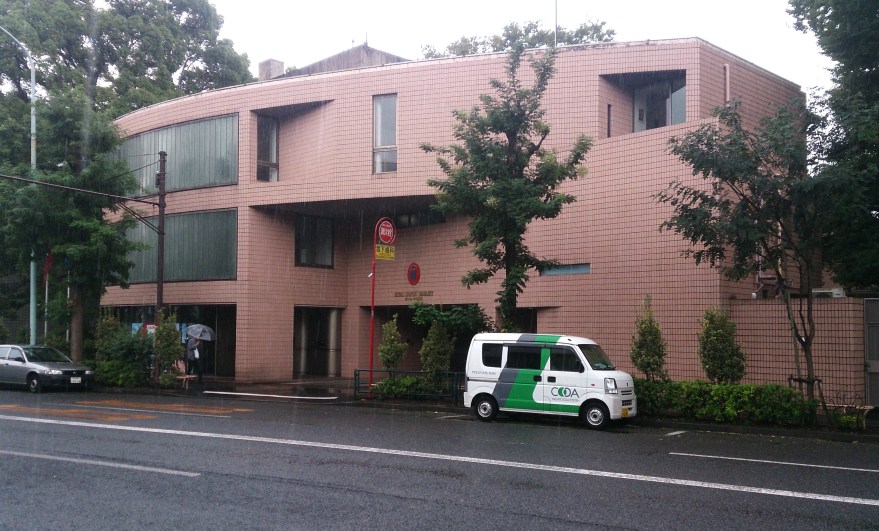
dsc_3166Located next to the Hillside Terrace, the Danish Embassy is designed by the same architect, Fumihiko Maki. Although the salmon pink tiles immediately distinguish the embassy from the adjacent developement, the treatement is quite similar. The chancery facade acknowledges the curve of the street it faces. The translucent windows give privacy to the office spaces, while shoji-like screens provide privacy to the upperlevel office units.


Name: Royal Danish Embassy│Type: Office│Architect: Fumihiko Maki │Completed: 1979

Location


1977 – Sogetsu Kaikan – Kenzo Tange

Replacing an earlier facility, designed also by Kenzo Tange, this headquarters for the Sogetsu school of flower arrangement is essentially L-shaped in plan. A slit at the corner suggests two separate prisms placed a hairsbreadth apart. The blue reflective glass is a nod to Sofu Teshigahara, the founde of the school, whose first name is written with a character meaning blue. Isamu  Noguchi designed the so-called ‘plaza’, a large installation on the first floor.


Name: Sogetsu Kaikan│Type: Office / Museum│Architect: Kenzo Tange │Completed: 1977

Location

1976 – From 1st Building – Kazamusa Yamashita

The From-First building is a complex building of offices and shopping facilities in a fast growing fashionable area of Tokyo, called Minami-Aoyama. It was not based on the functional flow planning, but on a free composition with a circular movement. The elevation consists of expressive irregularities. The exterior and interior facade is covered with red brick tiles. The building is an outstanding example of early deconstruction architecture.


Name: From 1st Building│Type: Office / Commercial│Architect: Kazamusa Yamashita │Completed: 1976

Location


1976 – Embassy of the USA – Cesar Pelli

1976 - Embassy of the USA - Cesar Pelli
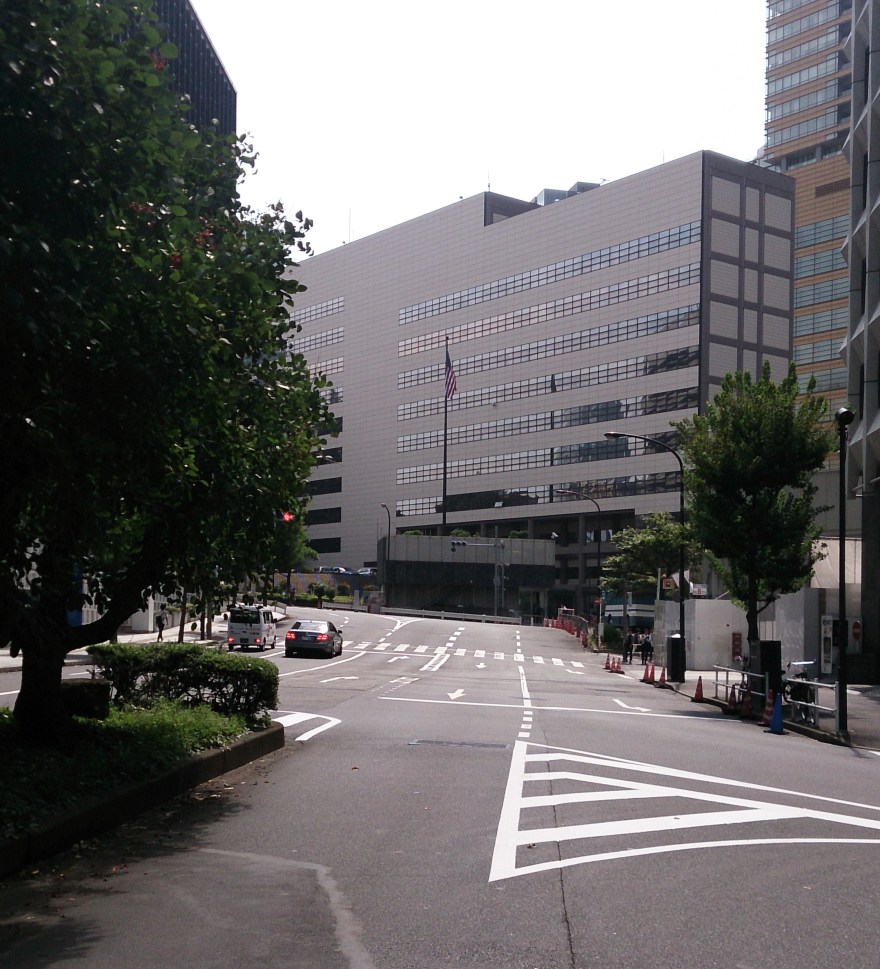
The building is made up of an 11-story east block and a two-two story west block, sitting on top of two basement floors. The tall block is steel-frame, the short block is reinforced concrete an the basement is steelframe reinforced concrete. The facade – an outsized banner of beige and blue – is scaled so as to be legible frm a speeding automobile.

Name: Embassy of the USA│Type: Office│Architect: Cesar Pelli │Completed: 1976

Location

1975 – Tokyo Metropolitan Art Museum – Kunio Maekawa

The museum building incorporates three functions: a permanent and thematic exhibition function, an exhibit function for art groups and a cultural activities function. In response to the fore-mentioned three required functions, Maekawa established a broad open space in the middle and arranged a the building around it to create his basic composition.

Maekawa also established three themes to guide the design: Providing a “quiet, neutral” backdrop for the exhibited works, maintaining connection with the exterior environment, and using materials and construction methods that ensure optimal durability and thereby ‘produce remarkable results by means of ordinary materials.’” (Excerpt from the “Tokyo Metropolitan Art Museum Basic Design Explanation”). On this basis, he worked out the concrete design details.
The critic, Shuichi Kato, wrote: “Tokyo streets have no order. Kunio Maekawa has consistently tried to produce small urban spaces in this chaotic context, through his arrangement of plural building volumes on the site. The courtyards and voids within the building’s walls perform not only as passageways but as open spaces to breath, relax, meet people, and talk. His buildings, this is to say, contain harmonious urban spaces on a reduced scale.”

Name: Tokyo Metropolitan Art Museum│Type: Museum│Architect: Kunio Maekawa │Completed: 1975

Location