1992 – Edo Toyko Museum – Kiyonori Kikutake

Kiyonori Kikutake designed the Edo Tokyo Museum to preserve “Edo,” the memory of Tokyo when it was known under feudalism. The foundations of modern Japan were laid during this time. It stands 62 meters tall, the same as Edo castle, with a pilaster design that opens up a public square below while establishing a monumental edifice for all to see. Completed in 1992, the museum exhibits a replica of Nihonbashi bridge, models of towns, and the Nakamuraza theatre. Like it or not, you must admit it portrays the isolationism and thirst for privilege of this time period.

Some buildings hug the earth. Buildings by Kiyonori Kikutake tend to keep the earth at arn’s length, or more. From Sky House (1958), his famous entry for the Kyoto International Conference Hall competition (1963) and Tokoen Hotel (1964) to Aquapolis (1975), a pavillon for the International Ocean Exposition in Okinawa, they rise, off teh ground or the water, as the case my be.

In the case of Edo Tokyo Museum, a vast open space is created underneath the building: the so-called Edo-Tokyo Plaza. The plaza, which has an area of 18’800 square meters, can be accessed from the west, north and east sides, and from it visitors take an escalator, either up to the main exhibition area (a double-height space) in the elevated superstructure below the plaza.


Name: Edo Toyko Museum │Type: Museum│Architect: Kiyonori Kikutake│Completed: 1992

Location

1992 – Tokyo Design Center – Mario Bellini

In addition to the problem of topography the Italian architect, Mario Bellini, had to rise to the further challenge of a U-shaped terrain, part of which was already occupied by another building. The solution is truly ingenious, and although one could certainly say that Bellini has grasped the Japanese sense of urban space, I don’t believe that there is another building like it in all Tokyo. It is a canonical principal of urban architecture that the representative prospect of a building be facing the public space and the rear façade receive a more informal treatment.

Bellini, however, has overturned that principle, keeping the main façade of the Design Center toned down, with the exception of the symbolically tall entrance space, and concentrated the force of the design on the back of the building. The strategy turned out to be brilliant. Seeing as the street front of the Design Center is inevitable cut in two by an existing building, an elaborate façade would have clashed with its banal curtain-wall. Bellini wisely decided not to undertake this duel.

His building withdraws behind a very uneventful façade. Curiously, the expedient of inverting the façades of the building is coherent with the traditional Japanese style of city homes. What makes this building memorable is the open side that by means of an imposing stair connects the street to the rear courtyard


Name: Tokyo Design Center │Type: Office / Commercial│Architect: Mario Bellini│Completed: 1992

Location

1991 – Meisei Web – Edward Suzuki

The narrow, nine-story high-tech residential tower has been design with steel and other metallic materials. Its is located at a broad roadway near to Meguro station. The triangular form of the plot creats the building’s iconographic expression. Architect, Edward Suzuki, decided to place the exterior staircase in the cone end of the building to reinforce this form. The structure of the building consits of in-situ exposed concrete. The secondary steel structure, beams and wire, is colored in a catchy turquoise.


Name: Meisei Web │Type: Office / Apartment│Architect: Edward Suzuki│Completed: 1991

Location

1991 – M2 Building – Kengo Kuma

M2, which stands beside Ring Road Number 8, was built as an automobile showroom for Mazda. It is a jumble of dentils, corbels, triglyphs and arches at different scales and a glass curtain wall topped by panels normaly used to contain traffic noise. Despite the illusion of masonry construction, the structure is reinforced concrete. Standing smack in the middle of this pile is an enormous column with an abbreviated shaft. Inside, the iconic column is discovered to be an atrium with glazed elevator shaft.

“I want to be a Piranesi for the electronic age” was a comment made by the architect at the time. The curtain wall and the highway barriers represent functionalism and modernism, and the classical motifs post-modernism. Combining this free-floating collage was intended to express the emergence of a new post-industrial relationship between the workplace and the home.


Name: M2 Building │Type: Commercial│Architect: Kengo Kuma│Completed: 1991

Location

1991 – Kounji Temple – Ryoji Suzuki

Not fare from Kenzo Tange’s Yukari Bunka Kindergarten, Kounji is a Zen temple of the Soto sect that has been newly introduced into a quiet residential district. Buddhist temples in Japan are associated with funerals, and the prospect of encountering doleful mourners and smelling burning incense on a regular basis was no universally welcomed in the neighbourhood. A temple long established in the district might have had the clout to push trough any building program, but a newcorner obviously had to be more circumspect. To appease nearby residents, the architect took advantage of the depressed, bowl-like topography of the site to lower the building’s profile. He organized the temple around a sunken courtyard more than seven meters below the street level.

In Japan, guidelines on the design of Buddhist temples do not exist. An abbot is free to bild his temple any way he likes, as long as he has the support of core parishoners. In this case, the chief priest wanted a traditional main hall with a tiled roof, but he had modern ideas in other respects and did not mind the auciliary facilities being modern in style.

Designing a main hall in the traditional manner was a challenge for Suzuki, who was mor familiar with the details of Italian Baroque architecture than those of Buddhist architecture. Rules of proportion had to be observed, though in one respect, the curcumstances were unprecedented. Most temple roofs are pitched steeply to make them more visible to someone looking up, but at Kounji, that would have produced a top-heavy apperance. The roof was therefore pitched at a lower than usual angle. A steel frame structure is used to support the roof, though nonstructural wood columns are introduced here and there for effect.


Name: Kounji Temple │Type: Ritual place│Architect: Ryoji Suzuki│Completed: 1991

Location

1991 – Embassy of Canada – Moriyama & Teshima Architects

The property of the Embassy of Canada is next to a park that was created on the former estate of Korekiyo Takahashi located on Aoyama Dori. Besides the embassy, the building was to accommodate space for lease, the income from tenants was to be used to defray the cost of construction. The land was to remain Canadian property.

Moriyama & Teshima, a Canadian office based in Toronto, designed the building in collaboration with Shimizu. The building was limited to eight stories because of the presence of Togu Palace across the street and the need to minimize disturbance of the park. The architects have explained the scheme using in terms for the three branches in the shoka form of flower arrangement, namely ten (heaven), chi (earth) and jin (man). The office block for lease on the bottom three floors represent chi, the fourth floor, withe the entrance lobby for the embassy, the exhibition and reception areas and a spacious garden, represent jin, and the embassy on the top floors under the sloping glass roof represent ten.


Name: Embassy of Canada │Type: Office│Architect: Moriyama & Teshima Architects│Completed: 1991

Location

1991 – Earthtecture Sub-1 – Shin Takamatsu

A Tokyo developer, who has produced some unique projects by appointing a different architect for each one, planned to construct an office building on a site in a quiet residential area. As a result of analyzing the strict legal restrictions on site coverage and building height, as well as the developer’s draft program, architect Shin Takamatsu’s idea was to construct the architecture mostly underground.

Visible above ground are only some skylights resembling butterfly wings, which draw daylight deep underground. The design of the skylights is completely in accordance with the rules of landscape gardening. It might be called a garden of light. One of the reasons the client assented the proposal, despite the huge expense of excavating a basement nearly 20m deep and providing countermeasures to deal with groundwater, was his faith in this garden design.


Name: Earthtecture Sub-1 │Type: Office│Architect: Shin Takamatsu│Completed: 1991

Location

1990 – Aoyama Technical College – Makato Sei Watanabe

Ayoma Technical College is an otherwise innocuous building surmounted by a sinister form suggesting a cross between an insect and a motorcycle. The design is based on the winning entry in a competition that had among its jurors Yoshiro Ikehara and Riken Yamanoto. The facility, located on a narrow street, contains classrooms, faculty space and a gallery. The ellipsodial formon the is a water tank and the two feeler-like appendages behind it are lightning rods. The “body” of the machine/insect is clad in aluminium panels in four colors.

The architect himself describes his work as following: “The Aoyama Technical College building is also intended to restore the fundamental strength that buildings ought to have. Ancient structures, from the Pyramids to the great cathedrals, possessed the awesome power of large spaces. Most of modern architecture, it seems to me, has lost this basic power. Architecture ought to be something capable of moving people’s hearts and giving them a physical thrill in a way possible in no other art. That power deserves to be restored. Another purpose of this building is to assure that anyone who might see it experiences, both mentally and physically, an definitive feeling of excitement.

The completion of this building proved a potent stimulus to the disorderly, chaotic area in which it stands. The effect of this structure proposing a new principle for creating architecture in the city will spread, helping people to stop and think about the way they want their cities to be. They can thus change their communities, as well as Tokyo as a whole, into better worlds.”


Name: Aoyama Technical College │Type: Education│Architect: Makato Sei Watanabe│Completed: 1990

Location

1990 – Watari-Um – Mario Botta

Designed by Swiss architect Mario Botta and opened in September 1990, the Watari Museum of Contemporary Art (Watari-um) cuts a striking profile on the edge of Harajuku and Gaienmae. The abbreviated ‘Watari-um’ derives from the combination of ‘Watari,’ the family name of the founders, and ‘Museum.’

The building takes advantage of the specific geometry offered by a triangular plot at the intersection of a mayor thoroughfare and a secondary side street. The confluence of the two façades is emphasised by the cut-out silhouette of the emergency stairway which projects up ahead the main façade with a curving skin, and also by the entrance to the building, an outstanding presence at grade level. The long incision which runs down through the middle of the façade to conclude at the base with a large rectangular display window is the only reference here to the internal organization of the building, which is articulated over six floors. The ground floor and basement are occupied by a bookshop; on the first, second and third floor are the exhibition rooms of the art gallery, while the top floors accommodate the offices and the owner’s residence.

From the urban and architectural point of view, and using the words of Mario Botta, the building “emerges as a Romanesque church in the midst of the great confusion and the diversity that surrounds it”


Name: Watari-Um │Type: Museum│Architect: Mario Botta│Completed: 1990

Location

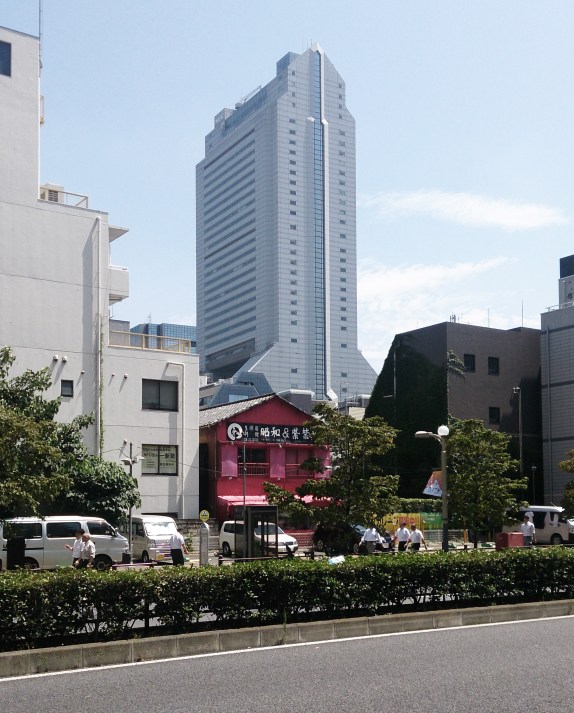
1990 – NEC Super Tower – Nikken Sekkei

1990 - NEC Super Tower - Nikken Sekkei

The 43-story head office is the first of what Nikken calls its “third generation” high-rise buildings, wherein design cosiderations include a substantial concern for the enviroment. In these Nikken buildings such concerns significantly shape the structural system an the overall form. Housing the headquarters of the well-known Japanese electronics giant, the building, as it soars upward, becomes narrower by two setbacks. The resulting shape ensures longer hours of sunshine to the surrounding area.

The designers also took advantage of the relatively generous site and surrounded the building with a “forest” of planted trees and greenery. Moreover, recognizing that high-rise structures create considerable wind turbulence at street level, the architects designed a large urban window: the building is pierced by a 42 meter wide and 15 meter high opening above the twelfth floor, after which the structure narrows. This solution could only be achieved with a large-span structural system. The super frame, applying box-like super columns and truss beams at every tenth level, concentrates the vertical load of the structure at its two shorter sides, wherein the vertical circulation, elevators and stairways, is also arranged.

This structural system, along with de “urban window”, allowed for the inclusion of a large atrium within the lower section of the building: this 45 meter high and 30 meter square atrium is outfitted with a same-size, crystalline skylight. In good weather teh skylight can be rolled away, opening the space below, which is protected in case of rain by the upper section.


Name: NEC Super Tower │Type: Commercial / Office│Architect: Nikken Sekkei │Completed: 1990

Location