
1975 – Tokyo Metropolitan Art Museum – Kunio Maekawa

1975 – Tokyo Metropolitan Art Museum – Kunio Maekawa

1975 – Tokyo Metropolitan Art Museum – Kunio Maekawa

1975 – Tokyo Metropolitan Art Museum – Kunio Maekawa

1975 – Tokyo Metropolitan Art Museum – Kunio Maekawa
The museum building incorporates three functions: a permanent and thematic exhibition function, an exhibit function for art groups and a cultural activities function. In response to the fore-mentioned three required functions, Maekawa established a broad open space in the middle and arranged a the building around it to create his basic composition.
Maekawa also established three themes to guide the design: Providing a “quiet, neutral” backdrop for the exhibited works, maintaining connection with the exterior environment, and using materials and construction methods that ensure optimal durability and thereby ‘produce remarkable results by means of ordinary materials.’” (Excerpt from the “Tokyo Metropolitan Art Museum Basic Design Explanation”). On this basis, he worked out the concrete design details.
The critic, Shuichi Kato, wrote: “Tokyo streets have no order. Kunio Maekawa has consistently tried to produce small urban spaces in this chaotic context, through his arrangement of plural building volumes on the site. The courtyards and voids within the building’s walls perform not only as passageways but as open spaces to breath, relax, meet people, and talk. His buildings, this is to say, contain harmonious urban spaces on a reduced scale.”
Name: Tokyo Metropolitan Art Museum│Type: Museum│Architect: Kunio Maekawa │Completed: 1975
Location

1975 – Reiyukai Shakaden Temple – Takenaka Corporation

1975 – Reiyukai Shakaden Temple – Takenaka Corporation

1975 – Reiyukai Shakaden Temple – Takenaka Corporation

1975 – Reiyukai Shakaden Temple – Takenaka Corporation

1975 – Reiyukai Shakaden Temple – Takenaka Corporation

1975 – Reiyukai Shakaden Temple – Takenaka Corporation

1975 – Reiyukai Shakaden Temple – Takenaka Corporation

1975 – Reiyukai Shakaden Temple – Takenaka Corporation
The Reiyukai Shakaden Temple in central Tokyo consists of the main hall, the public plaza, Kotani hall, conference rooms and a medical center. The temple was completed in 1975, after four years of construction. The main hall has a capacity of 3’500 people. The roof and facade is covered with dark granite, its formal expression is inspired by traditional temple roof. The eclectic architecture of Reiyukai Shakaden is influenced by Seiichi Shirai’s idea of the bizzare.
Name: Reiyukai Shakaden Temple│Type: Temple│Architect: Takenaka Corporation │Completed: 1975
Location

Shaped with a peculiarly sharpe edge as its north facade, the building cuts into the space of the busy Eitai Dori Avenue it faces. On the east side, the facade is covered with polished stone-covered vertical wall segments which are also triangular. This project by the highly versatile Togo Murano brought his architecture close to Seiichi Shirai’s design paradigm of the bizzare (see: Noa Building, 1974).
Name: Mizuho Corporate Bank│Type: Office│Architect: Togo Murano │Completed: 1974
Location
Built in 1974, the 15-storey building consists of a red-brick pedestal of about 8 meters height and a steel-covered and sculpture-like oval upper part that is dotted with very few windows, although the 8th floor has a full-length one. Monumental is the rusticated red brick lower section, which acts as a podium on which sits the high, oval block. To heighten the effect, an oversized and super-human arched gate leads to a rather dark, almost cryptiv entry space.
Name: Noa Building│Type: Office│Architect: Seiichi Shirai │Completed: 1974
Location

1976 – House in Uehara – Kazuo Shinohara

1976 – House in Uehara – Kazuo Shinohara

1976 – House in Uehara – Kazuo Shinohara

1976 – House in Uehara – Kazuo Shinohara

1976 – House in Uehara – Kazuo Shinohara

1976 – House in Uehara – Kazuo Shinohara

1976 – House in Uehara – Kazuo Shinohara

1976 – House in Uehara – Kazuo Shinohara

1976 – House in Uehara – Kazuo Shinohara
This house is located in Uehara, a well-to-do suburb of Tokyo less than half an hour from the city’s financial district. Consequently, the Uehara lot is quite small and the dwelling itself is some 9 metres on one side with no garden, while the main façade and carport give directly onto the narrow road. The client was an art photographer and the ground floor comprises his studio with a darkroom.
The upper storey is composed principally of the standard Japanese living-dining-kitchen space, although the kitchen and stair areas are partially screened by a massive articulated concrete pillar. This monolith burgeons with great struts rising to support the beamless concrete flat-slab roof and is part of a giant forest-like order whose tops are imposed and revealed throughout the residential storey.
Name: House in Uehara│Type: residential│Architect: Kazuo Shinohara │Completed: 1976
Location


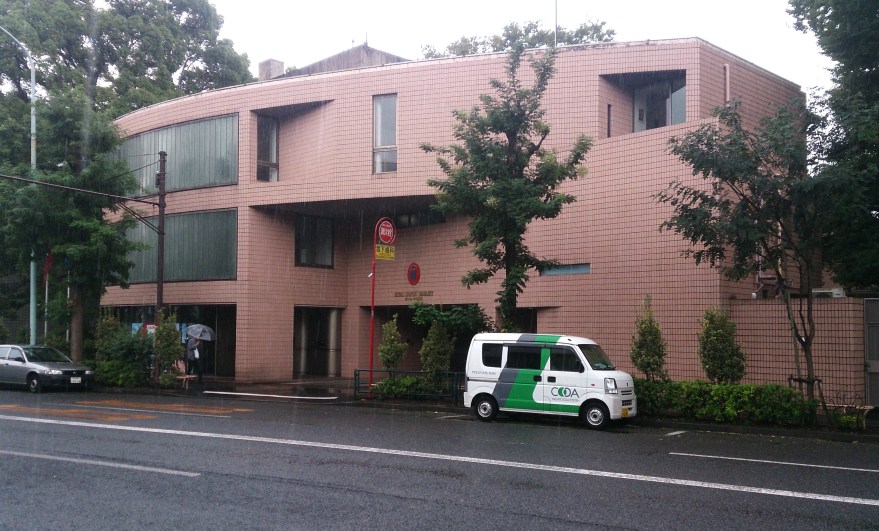 Located next to the Hillside Terrace, the Danish Embassy is designed by the same architect, Fumihiko Maki. Although the salmon pink tiles immediately distinguish the embassy from the adjacent developement, the treatement is quite similar. The chancery facade acknowledges the curve of the street it faces. The translucent windows give privacy to the office spaces, while shoji-like screens provide privacy to the upperlevel office units.




 architecture tokyo