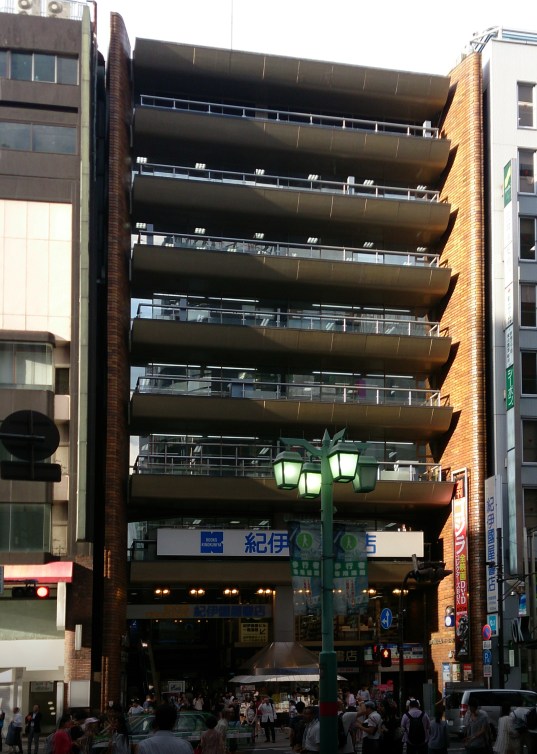
1966 – Palace Side Building – Nikken Sekkei

The building, facing the Imperial Palace, was at the time of its completion one of the largest commercial complexes in Tokyo. At street level there is a two-story shopping arcade linked to the streets around. The two cylindrical shafts, reminiscent of numerous Metabolist designs, feature stairways and elevators along with their lobbies. Particularly noteworthy is the mode in which the elevations are articulated with delicately designed metallic louvers as wel as drainpipes and spandrels. Such craftsmanship lends this impressive building an aesthetic quality that is akin to traditional solutions of high-level artistry.


Name: Palace Side Building│Type: Office / Commercial│Architect: Nikken Sekkei Ltd.│Completed: 1966

Location

1966 – Meguro Ward Office (former Chiyoda Life Insurance Building) – Togo Murano

Architect Togo Murano designed this large complex with a U-shape configuration so as to surround the sunken Japanese-style garden with a small pond and an equally small structure that originally served as a teahouse. The multi-story blocks are charaterized by well-proportioned volumes and the extensive us of cast aluminium louvers in modular system and arranged in front of the glass facades. This modern exterior is contrasted by a delicately “eclectic” interior. The centerpiece of the entrance hall is a curving staircase, which connects several floors.

1966 – Meguro Ward Office (former Chiyoda Life Insurance Building) – Togo Murano


Name: Meguro Ward Office│Type: Office│Architect: Togo Murano│Completed: 1966

Location


1966 – Tower House – Takamitsu Azuma

When Takamitsu Azuma moved from Osaka to Tokyo in 1966 he built a house for his family. Designed as a continual vertical room for the architect´s own family, the staircase appears as the most significant structure in the house´s interior. It connects the individual rooms, which are “piled” one on top of the other without any doors separating them.  Outside and inside, the Tower House is in raw concrete with a visible horizontal texture which contributes to underline the stacking floors. A small public passage is used as well as parking. Once completed, the raw-concrete tower could have been considered the “skyscraper” of Jingumae, overtopping by far the adjacent buildings.  The Tower House is a fascinating portrait of how Japan society has dealt with the urban and social changes in the last few decades.


Name: Tower House│Type: Residential│Architect: Takamitsu Azuma│Completed: 1966

Location

1964 – St. Mary Cathedral – Kenzo Tange

The St. Mary Cathedral has been completed in 1964, replacing the old wooden cathedral, in gothic style, burnt during wartime. Tange conceived the new church as a concrete structure, simple in concept and complex in shape, which recalls the lightness of a bird and its wings. The eight walls – the elements which hold the whole structure – are at the same time roof and walls, enclosing the space and opening to the outside through vertical gaps. The walls are curved hyperbolically to express the tension to the sky, and turning the rhomboidal ground floor into a cross at the roof top. The different heights of the wings, asymmetrical, make it a dynamic shape on the sky background. The highest wing is 39,41 m high.


The reflection of the sunlight on the stainless steel external cladding looks as a shining dress on the hard concrete slabs. Although it is a monochromatic cladding, the curves and the U-shaped profiles enhance the dynamicity of the structure. It all makes the church an iconic building in the dense urban context of Tokyo. The effect of the light on the curved walls, changing at every hour, makes the interior atmosphere extremely involving: direct sunlight and diffused reflections accompany the bending surfaces, and the visitor can immediately see and understand the curving of the concrete walls. St. Mary Cathedral is considered one of the most important of Tange’s work, and one of the most interesting architectures in Tokyo. The building puts together an occidental subject and the oriental culture and sensibility, resolving the complexity of the project in a brilliant architecture.

Name: St. Mary Cathedral│Type: Church│Architect: Kenzo Tange│Completed: 1964

Location

1964 – Nippon Budōkan – Mamoru Yamada

In 1964, the inauguration of two buildings designed by the Japanese architect Mamoru Yamada have sparked a lot of controvers. If the lighthouse shape of the Kyoto Tower was criticized by being too modern for the ancient city, the Japan Martial Arts Hall – Nippon Budokan – from Tokyo was criticized for being too traditional.

Built for the Judo competition of the 1964 Olympics, the Budokan’s architecture was inspired by an old architectural masterpiece, the Yumedono (Hall of Dreams) from Hōryū-ji, Nara, the most famous building of its kind. The architect preserved in its design both the underlying pedestal and the octagonal shape of the roof , with a big giboshi (sacred gem protecting against evil spirits) on top.


Name: Nippon Budōkan│Type: Stadium│Architect: Mamoru Yamada│Completed: 1964

Location

1964 – Yoyogi National Gymnasium – Kenzo Tange

Built for the 1964 Summer Olympic Games in Tokyo the Yoyogi National Gymnasium has become an architectural icon for its distinctive design.  Designed by one of Japan’s most famous modernist architects, Kenzo Tange, the gymnasium is a hybridization of western modernist aesthetics and traditional Japanese architecture. Tange’s innovative structural design creates dramatic sweeping curves that appear to effortlessly drape from two large, central supporting cables. It’s dynamically suspended roof and rough materials form one of the most iconic building profiles in the world.


Name: Yoyogi National Gymnasium│Type: Sports│Architect: Kenzo Tange│Completed: 1964

Location

1964 – Komazawa Olympic Park Control Tower – Yoshinobu Ashihara

This iconic concrete tower designed by architect Yoshinobu Ashihara became the outstanding landmark of Konazawa Olympic Park. Its structure refers to traditional Japanese wood architecture, but is transformed to a modernist shape and construction. What originally was facing concrete is today unfortunately painted white.


Name: Komazawa Olympic Park Control Tower│Type: Infrastructure│Architect: Yoshinobu Ashihara│Completed: 1964

Location

1964 – Kinokuniya Bookstore – Kunio Maekawa

1964 Kinokuniya Kunio Maekawa

After World War II Kunio Maekawa founded a company specialized in production of prefab concrete elements which you also find in this project: The 40 meters deep and 9-storey high building is placed in the busy shopping area of Shinjuku. Its basement is directly connected to the subway station. Originally the Kinokuniya bookstore was only on the first and second floor – besides there was also a restaurant and an auditorium. Today the complete building is used as a bookstore.


Name: Kinokuniya Bookstore│Type: Commercial│Architect: Kunio Maekawa│Completed: 1964

Location

1962 – Komazawa Olympic Park Stadium – Murata Masachika Architects

The Olympic Park was the site of the second venue for the Tokyo Olympics in 1964, hosting wrestling, volleyball, and other competitions. It was opened to the public after the Olympics as a park, and today is known as a sports park that harmoniously blends greenery with several types of athletic facilities.

Komazawa Olympic Park Stadium is a multi-purpose stadium and currently used mostly for football matches (although mostly amateur and women’s matches) as well as American football games and athletics. The stadium holds 20,010 people. The stadium hosted some of the football preliminaries for the 1964 Summer Olympics. Worth seeing is the plant-like concrete structure of the roof on its west side.


Name: Komazawa Olympic Park Stadium│Type: Stadium│Architect: Murata Masachika Architects│Completed: 1962

Location