2007 – Undercover Lab – Klein Dytham

Undercover Lab is a building, which is undercover. Not only is it tucked away in the back streets of Harajuku but the site is also very deceiving. A 10 m long narrow driveway leads to a 12m x 12m site at the rear.

The building houses a studio, press showroom, and office. A 20 m long hanger rail to show the entire collection of one season was required. This is housed in a black tube running along the only 20 m straight line on the site, which extends out over the entrance driveway. This cantilevered tube extends the building’s influence to the main street in a strong but stealthy way.

The tube was made to look as anonymous as possible, almost like a shipping container where you have no idea of its contents. The tube also intimates the form of tools such as telescopes, imparting a mysterious feel, but without revealing its true purpose.

The basement and first floor structure had to be concrete, but the client was not keen on the look and feel of this material when it was left exposed, so to overcome this we simply left the formwork on the structure of the walls and ceilings. Recycled wood from an old school was used for all the floor in the building, leading to a warm friendly feel.


Name: Undercover Lab│Type: Commercial / Office│Architect: Klein Dytham│Completed: 2007

Location

2007 – National Art Center – Kisho Kurokawa

The National Art Centeris located in the Roppongi district in the center of Tokyo. Roppongi is a downtown area known for its numerous high-scale restaurants, boutiques, foreign offices in addition to being home to many ‘creators’. The building is made up of seven enormous column-less display rooms, each 2000m², a library, an auditorium, a restaurant, a cafe and a museum shop. The floor area of the National Art Center totals 45,000m², making it Japan’s largest museum.

The National Art Center, Tokyo will not be a space for archiving works of art, but is a space for exhibiting public open exhibits and travelling exhibits. Large exhibitions will begin in the basement, where works will be brought in one by one at the loading area and only the pieces selected will be brought by service elevator to the display blocks. Medium and small sized public exhibits will most often be held in one ‘block’ and will be judged, separated, held and displayed as they are unloaded from trucks in the basement in a functional rhythm. One display ‘block’ can, moreover, be divided by partitions creating smaller spaces.

Designed to rival the mechanical display space is the atrium facade, an enormous transparent undulation. As the trees surrounding the museum grow, they will enclose the atrium in a forested public space. Also in the atrium space are two inverted cones, the upper portion of both featuring the restaurant and cafe.


Name: National Art Center│Type: Museum│Architect: Kisho Kurokawa│Completed: 2007

Location

2007 – Gyre – MVRDV

Recent developments in the Omotesando shopping district could be characterized as a spectacular series of buildings, each of them a box with a magnificent façade and often modest interior. Most of these buildings are flagship stores for major fashion brands. They seem to concentrate on the development of the skin, the façade, and are designed as giant advertisements. They are the architectural equivalent of supermodels. But like supermodels they can also be intimidating because of their beauty.

The architects asked themselves: How can a new building here compete with these developments? How can it make a critical comment on them? And can such a building be more than merely decoration? Why not pick up a where an earlier strand of development left off: the Spiral Building by Maki in 1985 followed by the YM Square building around the corner form Omotesando, in Harajuku in 2001. These buildings focus on the vertical movement of the visitors and are more public, less exclusive or intimidating than fashionable ‘name-brand’ buildings. But the real qualities of these buildings are not directly visible from the street and they lack the iconic exterior qualities of more recent Omotesando stores.

The new building needed to provide real estate flexibility, serving one or several occupants or companies. It should therefore communicate on both scale levels, on the level of the building as a whole and on the level of the independent shops inside the building.The program consists of 7 floors each with a surface of 60 percent of the total plot. By twisting these floors gradually around a central core, a series of terraces emerge connected by stairs and elevators that are placed outside the volumes. They create a twin pair of two vertical stepped terraced streets, on each side of the core. One is for ascending and the other for descending. The route will spiral upwards from Omotesando Street and then descend towards Cat Street, activating both streets.

These two routes are connected at every level through the block, by passing or crossing a shop or a series of shops around the inside atrium. This creates an attractive spectacle from outside. It produces a highly iconic and sculptural figure a building that attracts and invites people, not only at the street level, but also towards companies and destinations higher up. It allows equal access to all floors. Combining a public route with a new iconic silhouette in Omotesando Street, it offers spectacular views of the surrounding district. It’s a new destination, and a new way of shopping : a vertical promenade.


Name: Gyre│Type: Commercial│Architect: MVRDV│Completed: 2007

Location

2006 – R-Minamiaoyama – Akihisa Hirata

This is a commercial complex located between Omotesando and Gaienmae. The outdoor stairs are created an interesting look that cut the glass surface at an angle. Architect Akihisa Hirata studied at Kyoto University. After his graduation he worked for Toyo Ito. He established his own office “akihisa hirata architecture office” in 2005.


Name: R-Minamiaoyama │Type: Commercial│Architect: Akihisa Hirata│Completed: 2006

Location

2006 – Pacific Square Miyamasuzakajo – Hiroyuki Wakabayashi

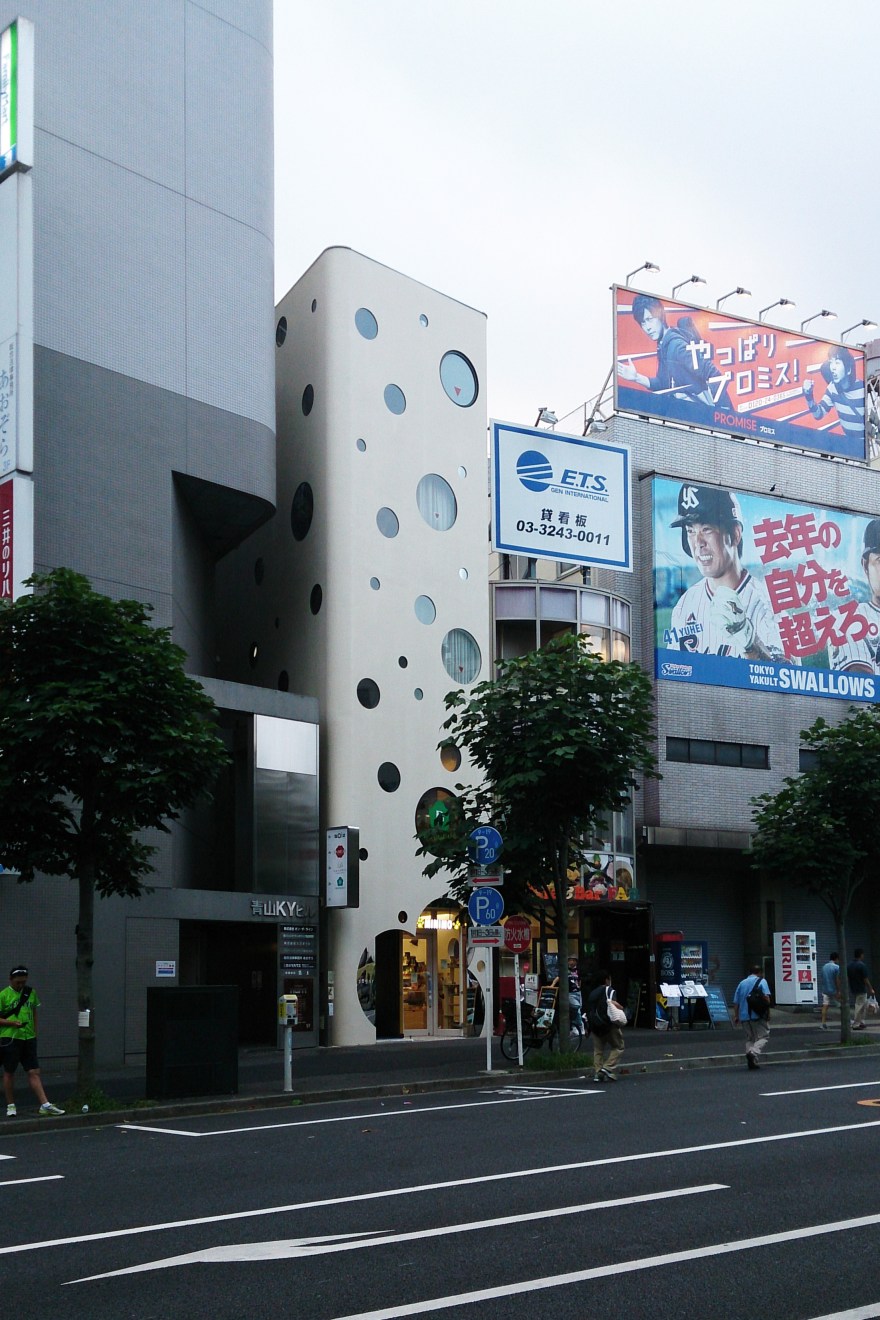
This narrow, 38-meters high building contains shops, restaurants and office space. Ist irregular facade with oval windows doesn’t allow the reading oft he nine storeys behind. The plan is as open and not limited to a specific use. The secondary rooms are organized along the narrow side. To mark he entrance the facade forms an inviting gesture. The facade is covered with dark brown mosaic tiles.


Name: Pacific Square Miyamasuzakajo│Type: Office / Commercial│Architect: Hiroyuki Wakabayashi│Completed: 2006

Location

2006 – Mado Building – Atelier Bow-Wow

The site is located in the wedge between a fork in the road on sloping land, so something with character as a landmark was sought by the client. The project is for speculative development – the land was bought, value added through design, tenants are found, and the project sold off.

In seeking out common criteria from responses to various separate external factors, such as the difference between levels on the site, the shading envelope, assumed circulation paths and so on, we came to feel the necessity of some internal rhythm. Here the architects started looking at the windows and balconies of the apartment buildings that surround the site, and in a mirroring relation, arranged openings in a chequered pattern on the three frontages facing roads. For the windows, the largest standard dimension for double glass windows was taken as a baseline, varying the proportions in response to external conditions. As a result, the exterior façade came to have in parts an elastic expression, suggesting movement.

The architects  placed an entrance in each frontage, and allowed this to be absorbed into the partial deformations of the repetition of windows in the façade, yielding parts revealing difference amidst the general pattern. The window can be understood here as an element that is shared in common with the surrounding context, as well as something engendering an internal rhythm; as a device that responds flexibly to external conditions while creating diverse internal settings; as a tool negotiating a multi-layered context. The name “Mado (means window in Japanese) Building” was taken from this.


Name: Mado Building│Type: Residential│Architect: Atelier Bow-Wow│Completed: 2006

Location

2006 – GHS – AAT Plus

2006 - GHS - AAT Plus

This 5-storey high commecial building designed by AAT Plus was completed in 2006. The outer-shell structural building. The usable area in the building can be acquired even on a narrow site to its maximum. The structure is semi-monocoque that uses steel plates of only 4.5mm thickness


Name: Audi Forum│Type: Commercial│Architect: Creative Designers International│Completed: 2006

Location

2006 – Audi Forum – Creative Designers International

The Team of Creative Designers International (CDI), founded in 1993 by British architect Benjamin Warner, has designed this building with contemporary lines to accommodate the Audi Forum Tokyo. Also known as ” The Iceberg “, the building was completed and officially opened in 2006. The Iceberg is a building with a unique crystal structure, representative of modern Japanese architecture, designed to reflect light from all angles. CDI director, Hiroyuki Yoshikawa, says that the inspiration for the exterior design was based on a combination of  ”crystal iceberg and a plastic bottle after going through a shredder PET ”.

With seven floors up the Audi Forum is a commercial building with a unique structural system that supports asymmetric glass facade and an elevator shaft completely transparent. A street level commercial space is used as a showroom for Audi cars, although there are numerous spaces for exhibition and presentation of new models in the building. The building also houses the offices of the automotive company in Japan and areas for art exhibitions.
In this particular construction triangular panels have been used for glass facades. Three different types of laminated glass and colored in blue tones enhance the effect on the edges of the building, making it look like a giant crystal that rises in the middle of town. The new building for the signature Audi has a complex geometry which reflects light from all angles, favored by the placement of silver layers in sections oblique angles of crystals, giving the flat glass a three-dimensional quality.


Name: Audi Forum│Type: Commercial│Architect: Creative Designers International│Completed: 2006

Location

2005 – Moriyama House – Ryue Nishizawa

Ryue Nishizawa came up with a new definition of private and community living. The Moriyama House is a flexible-format of minimalist steel prefab house for Yasuo Moriyama, a perfect example of a home designed like a community while connecting the inside and outside.

Located in the suburbs of Tokyo, this modern architectural concept presents a multi-building residence with ten separate buildings, ranging from 1 to 3 stories high, where every room is a building by itself – even owner Moriyama’s bathroom is a separate building. The buildings are all prefabricated houses, which use steel plating to make the walls as thin as possible, in order to maximize the interior space.

In this house, the client is given the freedom to decide which part of this cluster of rooms is to be used as a residence or as rental rooms. He may switch among the series of living and dining rooms or use several rooms at a time according to the season or other circumstances. The domain of the residence changes after his own life.

In between the buildings one finds small gardens and pathways that are open to the street while connecting the different structures. The project blurs the boundaries between what we perceive as private and public property.

Ryue Nishizawa defined his concept as following: “In this house, the client is given the freedom to decide which part of this cluster of rooms is to be used as a residence or as rental rooms. He may switch among the series of living and dining rooms or use several rooms at a time according to the season or other circumstances. The domain of the residence changes after his own life.”


Name: Moriyama House│Type: Residential│Architect: Ryue Nishizawa│Completed: 2005

Location

2005 – Mikimoto Ginza – Toyo Ito / Taisei Design

The building of apparent simplicity comprises a prism perforated by a series of irregular windows, like a Swiss cheese, apparently arranged at random. However, since some of these are placed in the corners (where typically would be a column) and as we look closely at the fine finish of the facade, is evident that a much a more sophisticated construction system was used. The concept is based on the building is held by its facade, leaving the internal spaces column-free.


Name: Mikimoto Ginza│Type: Commercial│Architect: Toyo Ito / Taisei Design│Completed: 2005

Location